

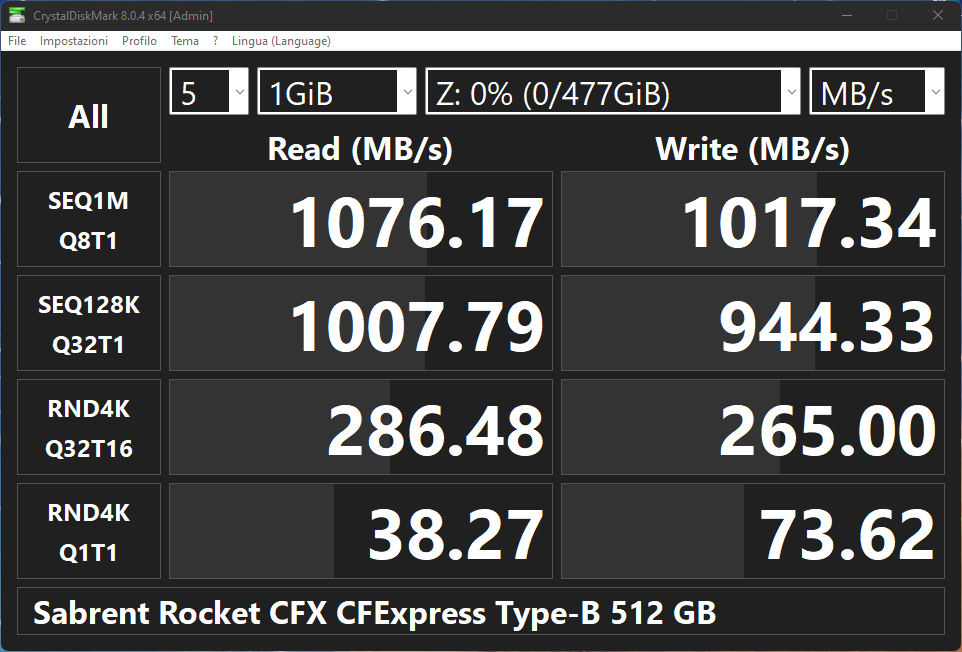
Ecco i risultati ottenuti dalla scheda in Crystal Disk Mark aggiornato alla versione 8.0.4:
Bar chart. Results are sorted by Write Seq1M Q8T1 to show the fastest card in terms of sequential write speeds.. Data table with 10 rows and 5 columns follows.
| Read Seq1M Q8T1 | Write Seq1M Q8T1 | Read 4K Q1T1 | Write 4K Q1T1 | |
|---|---|---|---|---|
| Sabrent Rocket CFX 512 GB (10 Gbps) | 1.076,2 | 1.017,3 | 38,3 | 73,6 |
| Kingston Canvas React Plus SDXC 256 GB | 299,9 | 290,4 | 11,6 | 2,5 |
| Sabrent Rocket V90 SDXC 64 GB | 309,5 | 287,8 | 11,6 | 2,2 |
| Sabrent Rocket V90 SDXC 128 GB | 311,2 | 287,1 | 10,9 | 2,2 |
| Angelbird AV PRO SDXC 128 GB | 301,2 | 257,8 | 10,7 | 2,7 |
| IRDM M2AA microSDXC 256 GB | 97,7 | 87,9 | 7,1 | 3,5 |
| Kingston Canvas React SDXC 256 GB | 97,7 | 79,5 | 5,2 | 4,3 |
| Patriot EP Pro SDXC 64 GB | 96,6 | 78,3 | 7 | 1,2 |
| Kingston SDXC 64 GB | 96,6 | 54,9 | 7,7 | 0,9 |
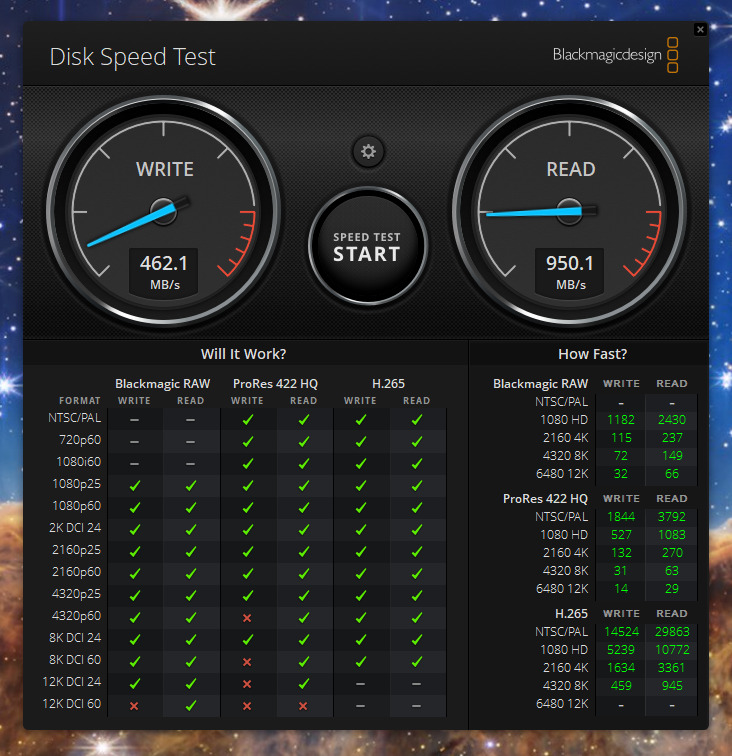
Ecco, invece, i risultati ottenuti con il benchmark Blackmagic Disk Speed Test:
Bar chart. Results are sorted by Read Speed to show if it is possible to work directly from the storage unit.. Data table with 10 rows and 3 columns follows.
| Write | Read | |
|---|---|---|
| Sabrent Rocket CFX 512 GB (10 Gbps) | 462,1 | 950,1 |
| Sabrent Rocket V90 SDXC 128 GB | 205,1 | 255,2 |
| Angelbird AV PRO SDXC 128 GB | 193,4 | 255 |
| Kingston Canvas React Plus SDXC 256 GB | 191,1 | 251 |
| Sabrent Rocket V90 SDXC 64 GB | 206,8 | 245,3 |
| IRDM M2AA microSDXC 256 GB | 83,8 | 93,3 |
| Kingston Canvas React SDXC 256 GB | 77,1 | 93,3 |
| Kingston SDXC 64 GB | 68,8 | 92,2 |
| Patriot EP Pro SDXC 64 GB | 80,2 | 92,1 |
A differenza delle SDXC finora testate, dove non era possibile avere una prospettiva delle prestazioni con codec più impegnativi come quelli 8K DCI e 12K DCI, in questo caso possiamo invece parlare di come si comporta la Rocket CFX in questi ambiti, viste le velocità sequenziali di cui è capace: se con Crystal Disk Mark praticamente saturiamo il bus USB 3.2 Gen2 (10 Gbps) di cui è capace il lettore di memory card di Sabrent, non arrivando minimamente ai livelli prestazionali dichiarati dall’azienda, con Blackmagic Disk Speed Test riusciamo invece ad avere un pratico riscontro grazie alla tabella del benchmark.
Stando a quanto rilevato, tenendo sempre a mente che il card reader non riesce a far raggiungere le prestazioni massime consentite dalla scheda, possiamo notare che a seconda del codec utilizzato, la Sabrent CFX da 512 GB riesce a gestire persino risoluzioni 12K DCI a 60 fotogrammi al secondo, seppure soltanto in lettura, mentre il formato 8K DCI (8192×4320 pixels) la memory card riesce a maneggiare praticamente qualsiasi bitrate, codec e framerate.
Con un card reader da 20 Gbps, su cui presto metteremo le mani, e con il modello di capacità più grande (che al pari degli SSD avrà prestazioni superiori ai tagli più piccoli) ci sono buone speranze che la scheda riesca a gestire anche qualche codec in più.


Discussione su post